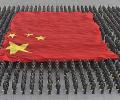
India has maintained there is no scope for a third party mediation.
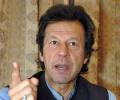
Pakistan's parliament on Wednesday became the new battleground in the ongoing political turmoil with pro-government leaders and lawmakers of Imran Khan's party accusing each other of undermining democracy, even as protesters returned to the negotiating table.

'By treating Nepali politicians as shabby buffoons to be pampered one day and collared another day, India badly exposed itself.' 'A belief got entrenched in the Nepalese mind that we are a dangerous neighbour,' observes Ambassador M K Bhadrakumar.

'BJP leaders are trying to save their lives in Punjab.'
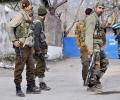
'It would be very easy for me to say, it's only the Pakistanis that want the Kashmir issue to remain alive.' 'Trust me, there is a vested interest on the Indian side in keeping the issue of Jammu and Kashmir alive.'

Pakistan's chief selector Inzamam-ul Haq criticised James Anderson for his uncharitable comments about Virat Kohli's technique, saying that the England pacer should first take wickets in India before questioning the Indian skipper's capabilities.

India on Sunday reaffirmed adherence to three conditions including having an atmosphere "free of terror and violence" as a precursor to any engagement with Pakistan and demanded action against terrorists including Mumbai attack mastermind Zakiur Rehman Lakhvi.

Before opening its first outlet in the country on November 9, the US fast food chain, Burger King Corporation, had approached the HC seeking an assurance that companies it had sued for trademark infringement will not approach lower courts for stay orders against its launch.

'Little did those in India's strategic community realise that any wise adversary in China's place and circumstances would only take the land route to disturb and trouble India.' 'It is along the land border that all of India's post-Cold War allies would be of little or no political and diplomatic, and least of all, military help,' says N Sathiya Moorthy.

"We are still in a state of shock at the martyrdom of our deputy chief and there is no change in our decision of not talking to the government," Tehrik-e-Taliban Pakistan spokesman Ihsanullah Ihsan said.

'Indira Gandhi and P N Haksar did not want Pakistan to leave as an embittered foe hell-bent on taking revenge for being humiliated so comprehensively.'
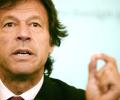
Cricketer-turned-politician Imran Khan has threatened to drag embattled Prime Minister Nawaz Sharif to the Supreme Court to seek his disqualification for allegedly lying about protesters and the army in parliament, as the political logjam showed no sign of easing.

'The BJP has bent. Pakistan has not changed a single thing. It is the BJP and its supporters who have changed. And this is a very good thing,' says Aakar Patel.

'It will be foolhardy to overlook that this stunning shift in China's stance comes as the culmination of the severely damaged India-China relationship under the present government,' says Ambassador M K Bhadrakumar.
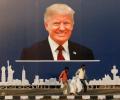
'It's the first-ever US presidential visit which is specially planned for India.' 'The standalone visit itself has achieved something already. Don't underestimate it.' Sheela Bhatt gives us an exclusive glimpse of what the Modi government hopes to achieve from Trump's visit.

Australian legend Matthew Hayden said India tour is a premium test event in their cricket culture and it is important to quickly resolve the pay dispute as there is a lot at stake.

'War cannot resolve problems. So wisdom is to resolve diplomatically.'

'Make no mistake, depriving water deliberately to a nation of 190 million people is a repugnant idea.' 'The world community won't forgive us.'

Girls in the Kashmir valley hurling defiance at the security forces will detract from the legitimacy of India's response and its standing in the world, says Ajai Shukla.

Possible US envoy says India must get assurance against China.
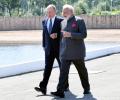
'The Vladivostok visit marks a subtle reversal of trend discernible in the revival of India-Russia relations pioneered by Modi during the past couple of years,' says Ambassador M K Bhadrakumar.
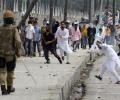
Stone-pelting youth were not giving up their lives for tourism but for resolution of the Kashmir issue as per the wishes of its people, National Conference president Farooq Abdullah on Wednesday said.
Experts say the treaty needs a review to address the ongoing and the likely impact of climate change on river-flow

Ranjita Ganesan finds out why an Akola businessman paid Dharma Productions for two tickets of Ae Dil Hai Mushkil.
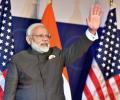
PM Modi addressed the Indian community in Washington DC after meeting chief executives of major US companies.

Israel is determined to take the bilateral engagement to a different level that goes beyond defence hardware and intelligence software. Kanchan Gupta reports exclusively from Tel Aviv for Rediff.com
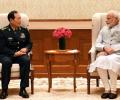
'China's military is expected to deploy full throttle its new equipment including J-20 stealth fighters, drones, medium range missile systems, surveillance and others to continue to put psychological pressure on India,' warns Srikanth Kondapalli, Professor in Chinese Studies, JNU.
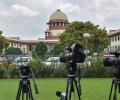
Verdicts paving the way for construction of a Ram Temple at Ayodhya and India's multi-billion dollar Rafale fighter jet deal with France were 2019's landmark imprints of the Supreme Court, which also found itself at the centre of a controversy with then Chief Justice of India Ranjan Gogoi being accused of sexual harassment before getting the clean chit.

Under pressure from political and other outfits, Bollywood film producers have announced that they will not engage with Pakistani artistes, clearing decks for the smooth release of Karan Johar's 'Ae Dil Hai Mushkil' as the MNS withdrew its threat to stall the screening.
During the hearing, Chief Justice of India JS Khehar also offered to serve as a mediator, if negotiations broke down.

'The domination of American foreign policy by the military poses some hidden dangers for us.' 'We must factor in that the Pakistani military and the US military have close ties going back three generations.' 'Pakistan will find sympathetic ears in the Pentagon against India as the bogey man.' 'This will be further milked to the maximum by raising the ante in Kashmir through its proxies,' warns Colonel Anil A Athale.

The jury is still out on whether the Obama-Sharif summit managed to repair the trust deficit and mutual suspicions. But if pleasantries and cordiality was the measure of this summit, it receives a resounding A+ grade, says Aziz Haniffa

Former External Affairs Minister Jaswant Singh believes that Nawaz Sharif could have been aware of Pakistan army's aggression in Kargil in 1999 despite the insistence by the then Pakistan prime minister that he did not know about it.
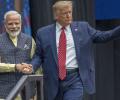
'The challenge before the two countries is to turn the peak into a plateau and enter an irreversible phase of cooperation,' notes Ambassador T P Sreenivasan.

'Pakistan's negativism should be seen as the reason for India losing interest in SAARC.'
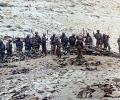
In fact, given the current tensions and massed troops on both sides, there is a danger that the LAC will become more like the Line of Control with Pakistan, a heavily fortified and strongly defended border where weapon fire exchanges regularly occur. Indeed, Stratfor Worldview research has listed a sharp increase in new Chinese facilities along the LAC in 2019-20.
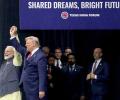
'The biggest takeaway is that the US-India relationship, which has sputtered a bit in recent months, enjoyed a big boost.'

'If there were no Ahmedabad programme -- no flashy town hall event in a huge cricket stadium with thousands cheering him on -- then Trump may well have decided not to go to India.'
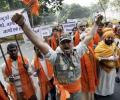
In the past four years, neither the BJP nor the VHP has shown any interest in the mandir or Lord Ram. Now that elections are nearing, it is attempting to whip up communal passions, says Minister of State for Home R P N Singh in an interview to Anita Katyal

'Qatar has been funding and supporting terrorist organisations.' 'It has used its media to spread lies and create unrest in neighbouring countries.'
